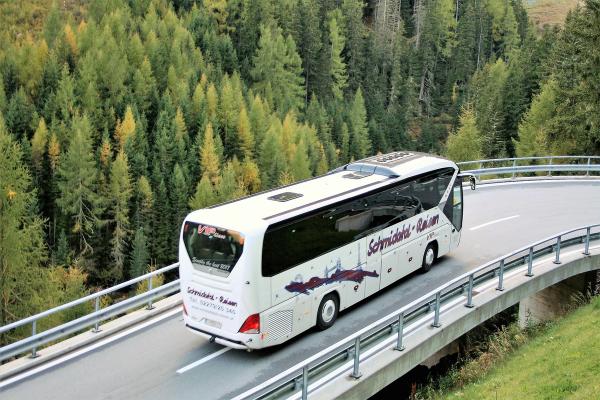
Employee transport is arranged by a great many businesses. It is not compulsory for every company, but it is frequently worth doing. The law sets out an employer's core obligations towards staff, and beyond that there is considerable room to build your own rules. By looking after the atmosphere at work and the convenience of the people you employ, a company earns loyalty and greater commitment in return. What that care looks like depends on the industry. If your business involves frequent travel and time away, employee transport is worth serious consideration — and that is far from the only argument for working with a transport company.
Staff transport can be arranged domestically or across borders. It is used both by employers recruiting seasonal workers in EU countries and by those who simply need to get people to a temporary site outside town. It also works well when a whole team needs to arrive together at a training day or a conference, or when a team-building trip is being organised. Working with a professional carrier operating in Katowice, across the wider Silesian conurbation, in Poland and in Europe brings advantages for the employer and for the workforce alike. So why is using a carrier better than taking on the job of arranging journeys yourself?
What employees and employers gain
Start with the point made above: the effect on your staff. Whatever the purpose of the journey, people who are driven rather than left to organise their own travel arrive rested and ready to work. Employees forced to drive themselves may turn up tired, and that shows up as reduced output, weaker concentration and poorer results. Nor is that the only drawback. Private cars and public transport frequently generate additional costs for the employer, and once you are moving more than a handful of people, arranged transport works out considerably cheaper.
Beyond pure economics there is the question of safety. Staff have to get there and back again. A tired body behind the wheel raises the risk of an accident, and the same fatigue reduces safety on the job when work begins immediately after a long drive. Even where an employer has covered every safety requirement on site, accidents can still happen — and that is worth bearing in mind. Arranged transport gives both sides peace of mind.
Convenience and safety
Look at those points alone and the conclusion is easy: working with an established carrier brings real benefits, and over time a company notices the difference in both cost and safety. But the advantages go further. Consider arrival times. Every employee lives somewhere different, so each has a different route, each can get stuck in traffic, and anyone unfamiliar with the way to a training venue or site will not necessarily pick the shortest one. Left to their own devices, people arrive late and the day starts in disarray. A transport company, by contrast, collects from the address you name, and its vehicles are always driven by someone experienced. The employer has no delays to worry about and every passenger arrives on schedule.
Employee comfort matters in its own right. Planning and preparing your own journey is an additional mental and physical burden, particularly over a long distance. Comfort is worth attending to especially on long routes and trips abroad — many hours in a car is wearing for anyone. A properly equipped vehicle makes the whole journey far less tiring. If you are looking for a transport company that delivers staff shuttles to a high standard, we would be glad to show you what we offer.
Investing in transport means investing in people
Transport can also be viewed from another angle. Every business is made of people, and it is human capital that decides whether it succeeds. Handing the journey to an outside carrier lifts a responsibility from your staff, and they notice it. Arriving at work or at a training day in a well-equipped vehicle tells employees they matter to the company, and they tend to apply themselves accordingly. Once people sense that an employer cares about working conditions and comfort, the psychological principle of reciprocity takes effect: they want to repay it with good work. Internal values reinforce themselves, which shows up as lower staff turnover on one side and a stronger reputation with clients on the other.
Own fleet or an external carrier?
Depending on where, how often and in what form your staff travel, a company can approach transport in different ways. You can of course run your own fleet, and there are situations where that is the most sensible option. In many cases, though, businesses decide against it, because once the numbers are worked through it turns out to be neither economical in the long run nor convenient logistically. What does investing in your own vehicles actually involve? Running a transport operation carries substantial costs. You need enough space to park the cars or minibuses. You have to budget not only for the purchase but for maintenance, servicing and insurance. And there are the running costs of the journeys themselves — not just fuel, which grows as a share of the budget the more you travel, but liability for every road incident and collision.
You also need a good driver. Is that going to be one of the people travelling with the team, or a separate post on the payroll? As you can see, the option demands careful thought. Building that capability internally takes real effort, which is precisely why most businesses choose the second route and work with an external carrier. Staff transport handled by a transport company saves money, reduces liability and frees up the time otherwise spent organising the whole process. Once a carrier is engaged, the employer no longer has to think about transport at all: the external company takes it on and delivers everyone quickly and safely.
Leaving transport to professionals
Business owners sometimes resist this on the grounds of cost, though usually as a first reaction, before the matter has been examined properly. Look more closely and carriers' rates compare very favourably against running everything in-house each time. Drivers employed by transport companies know the best routes, so they arrive on time. Their vehicles cover not only Silesia but the rest of Poland and the European Union. Requirements vary enormously: some companies travel almost entirely within one region, while for others the significant industry events are all abroad. Using a carrier means an experienced driver who can find their way in any city, keep everyone safe on the road, and get every passenger there on time.
When daily commuting is worth funding
More and more companies are choosing to transport staff not only on business trips but on every working day. It sounds mundane, but if your premises sit on the edge of town where public transport runs rarely or not at all, difficulty getting to work can become one of the reasons people leave. It is particularly awkward for employees without a car of their own, or where shifts run through the night and buses and trams have effectively stopped.
With an inconvenient location, companies can lose good, experienced people. The difficulty of the commute becomes wearing enough that the idea of a job closer to home starts to look attractive. An employer who spots this early — especially one employing a large workforce — should consider a daily staff shuttle. As with trips and training, it provides safety and meets a genuine expectation, and it helps retain people who are already trained and productive.
Staff shuttles are not the limit
Transport companies work hard to meet what their clients actually need, so any number of people can be delivered to any address. Where employees simply need to reach their workplace, they are taken there directly. But hiring a minibus or coach does not have to mean a staff shuttle, and routes sometimes change — which makes it worth choosing a carrier that offers some flexibility. When does that matter?
It matters when the trip has a looser character. Company travel divides broadly into two categories. The first is the team-building trip: a chance to rest and strengthen relationships. It is not only a way to step back from daily duties but a chance to observe how individuals behave and who has the makings of a leader. On trips like these it is often worth taking the scenic route and stopping somewhere of interest along the way. Carriers know the good locations and can help with that too — a stop at an attraction makes the journey itself part of the experience.
Reward trips
The second category is the reward trip. These are arranged less often than team-building events, but they are worth building into company policy. Every business has its own approach to motivating people, and recognising achievement does not always have to mean a transfer into someone's account. Alternatives are sometimes more effective — a trip for the best-performing staff, for instance. A reward of that kind produces lasting memories and motivates further effort. Depending on the company's ambitions and budget, it can be arranged in Poland or abroad.
The prospect of a trip ahead gives a team an extra reason to work well. Here too, drivers' knowledge of what is worth seeing in the towns along the route can prove invaluable. It is also worth remembering that transport companies are not only for businesses: private hire is available as well, and it works particularly well for bringing guests to an occasion such as a wedding or a first communion.
Employee transport and Polish law
Staff transport has clear advantages, but it also raises questions — whether it counts as employee income, for instance, or whether travelling time should be counted as working time. Free transport makes obvious sense where the workplace lies outside town, as described above. It is also indicated where the place of work moves and staff have to reach it, as with construction sites. Some experts hold that transport should be taxed; others make it depend on the form it takes. The statute states that taxable income includes the value of benefits in kind received by individuals. On the other hand, valuing the service is difficult when employees live in different places and it is not always recorded who actually travels.
Free transport is broadly divided into two categories, and that division determines whether the exemption in Article 21 of the Polish Personal Income Tax Act applies. The first case is where employees are taken to the company's premises and only then on to the place where the work is performed — here no income arises from a benefit in kind. The second is transport to the company's premises itself. Under Article 21(1)(14a) of the PIT Act, the value of transport organised in accordance with Article 2(41) of the Road Traffic Act is exempt from tax. That provision refers to a motor vehicle carrying more than nine people including the driver.
The second question concerns whether travelling time counts as working time. Unfortunately, even where a journey takes several hours, staff transport cannot be counted towards hours worked in a day unless the employment contract contains specific provisions to that effect.
This article describes Polish regulations as they stood at the time of writing and is intended as general guidance, not tax advice. Confirm your own position with an accountant or tax adviser.